Insights
Employee Ownership Trusts Explained: Is an EOT Right for Your Business?
Employee Ownership Trusts let you sell your business to your employees, often with significant tax advantages. Here's how EOTs work, what sellers receive, and when they're the right choice.
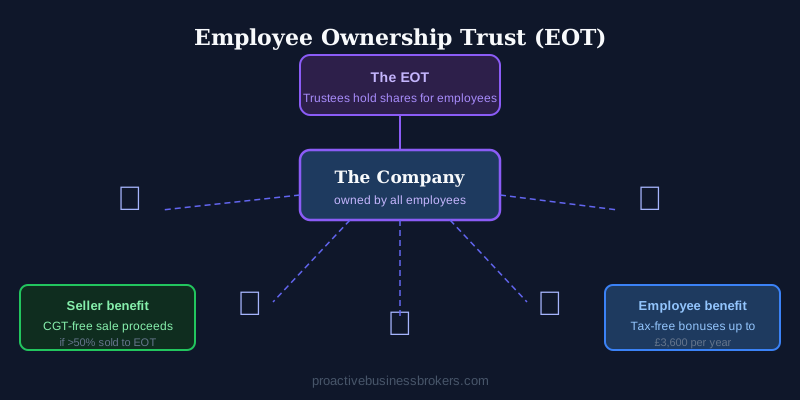
Key Takeaways: An Employee Ownership Trust (EOT) allows you to sell a controlling stake in your business to a trust held for the benefit of your employees — entirely free of Capital Gains Tax. Employees receive up to £3,600 per year in tax-free bonuses. EOTs work best where employee ownership genuinely fits the culture and where the business can service the deferred consideration from future profits. EOT sales typically take 3–6 months to complete.
What is an Employee Ownership Trust?
An Employee Ownership Trust (EOT) is a form of indirect employee ownership in which a trust acquires a controlling stake (more than 50%) of a company and holds it for the long-term benefit of all employees. EOTs were introduced by the UK government in 2014 to encourage employee ownership and have grown significantly in popularity since.
The model differs from individual employee share schemes. Employees don't each receive shares directly — instead, the trust owns the company on their behalf, and employees benefit through profit-sharing bonuses, a voice in the business, and job security.
Notable UK businesses have converted to EOT ownership, including Richer Sounds, Arup, and John Lewis Partnership — though the model is well suited to businesses of all sizes.
What are the tax benefits for sellers?
This is the headline: UK shareholders who sell a controlling interest to an EOT pay no Capital Gains Tax on the proceeds. For comparison, the standard CGT rate on business asset disposals is 24%, and even with Business Asset Disposal Relief the rate is 14% (rising to 18% from April 2026) on the first £1 million of gains.
On a £3 million sale, that could represent a tax saving of £600,000 or more compared to a standard sale. This CGT exemption is the primary reason EOTs have grown rapidly as an exit route in the UK.
Employees also benefit: once the business is EOT-owned, it can pay each employee up to £3,600 per year in Income Tax-free bonuses — a significant retention and engagement tool.
How does the sale process work?
The mechanics of an EOT sale are different from a conventional acquisition. Because employees don't have personal capital to pay for the business, the consideration is typically deferred — funded from the company's future profits over a period of years.
The structure usually works as follows: the trust is established as a special purpose vehicle. It acquires the shares from the owner at an agreed fair market value. The company then distributes its profits to the trust, which uses those distributions to pay the deferred consideration to the former owner over time — typically 3–7 years.
Sellers effectively become creditors of the trust during the repayment period, receiving capital over time rather than a lump sum at completion. This is a meaningful distinction from a conventional sale — but the CGT exemption often more than compensates for the deferred receipt.
What are the requirements for an EOT?
Not every business qualifies. HMRC sets specific conditions that must be met for the CGT exemption to apply:
Controlling stake: The EOT must acquire more than 50% of the ordinary shares, giving it genuine control of the company.
All-employee benefit: The trust must be set up for the benefit of all employees on the same terms (though it can differentiate based on length of service, remuneration, or hours worked).
Trading company: The business must be a trading company, or the holding company of a trading group. Investment companies and businesses with significant non-trading activity generally do not qualify.
No disqualifying arrangements: There must be no arrangements in place that would result in the trust's controlling interest being transferred back to private shareholders within the same tax year.
Number of employees: There are restrictions on the proportion of shares held by participators (broadly, shareholders with more than 5% of the company) in certain circumstances. Specialist advice is essential.
When is an EOT the right choice?
An EOT is not right for every business or every seller, and it's important to be clear-eyed about where it works and where it doesn't.
EOTs are well suited to businesses where employees are genuinely central to the value of the business — professional services firms, creative agencies, specialist manufacturers, healthcare practices. They work best where the owner cares about legacy and culture, not just the highest sale price. And they're most viable where the business has strong, predictable cash flows that can service the deferred consideration over a reasonable period.
EOTs are less suitable where the owner needs an immediate lump sum (a conventional sale or MBO will serve better), where the business is highly capital-intensive and cash flows are uncertain, or where there is no management team capable of running the business post-sale without the owner's day-to-day involvement.
What happens to governance after an EOT sale?
Once the EOT owns the business, governance typically involves a mix of independent trustees and employee representatives sitting on the trust board, alongside a management board that runs the business operationally. The former owner may step back immediately, stay on in an advisory capacity, or remain as a director during a transition period — this is agreed as part of the deal.
Employee engagement typically increases significantly post-sale. Knowing they benefit from the company's profits, employees tend to be more motivated and invested in the outcome. Staff turnover in EOT businesses is often lower than in conventionally-owned businesses.
EOT vs MBO vs trade sale: how do they compare?
Each route offers a different balance of price, speed, continuity, and tax efficiency. A trade sale typically delivers the highest headline price, particularly where there are strategic acquirers with genuine synergies. An MBO preserves management continuity but may deliver less than a trade sale. An EOT offers the best tax outcome for the seller but involves deferred receipt of proceeds.
Many owners benefit from exploring all three options before committing to a route. A good broker can model the after-tax proceeds from each scenario and help you understand what you would actually take home — which is often a more instructive comparison than the headline price.
Frequently asked questions
Can I still work in the business after selling to an EOT?
Yes. Many founders remain involved for a transition period — sometimes several years — in an executive or advisory capacity. The terms of your continued involvement are negotiated as part of the transaction. Some sellers step back immediately; others remain deeply engaged. The flexibility here is one of the advantages of the EOT route compared to some trade sales.
What is the valuation process for an EOT sale?
The business must be sold to the EOT at fair market value — HMRC requires this. An independent valuation is typically commissioned to establish the price, which then forms the basis for the deferred consideration structure. Because you can't sell at an artificially low price to avoid CGT (the CGT is already zero), the valuation process is straightforward and both parties have incentives to agree a fair figure.
How long does an EOT transaction take?
Most EOT transactions complete within 3–6 months from initial decision to legal completion. This is typically faster than a full market sale, since there is no buyer identification or marketing phase. The main time requirements are establishing the trust, obtaining an independent valuation, and completing the legal documentation.
Are there any downsides to selling to an EOT?
The main trade-off is deferred receipt. You will not receive a lump sum at completion — the consideration is paid from the company's future profits, which carries a degree of risk if trading conditions deteriorate. Some sellers also feel that an EOT removes the discipline that comes with an external owner holding management accountable. These are genuine considerations that deserve careful thought alongside the tax advantages.
Useful next steps
Ready to go further? These free tools and guides are a good place to start.
Thinking about what’s next for your business?
Book a confidential, no-obligation discovery call and let’s talk through your options.