Insights
How to Find a Buyer for Your Business: What Every Seller Needs to Know
Finding the right buyer for your business takes more than posting on a listing site. This guide explains the different buyer types, how professional brokers source buyers, and what you can do to maximise your chances of a successful sale.
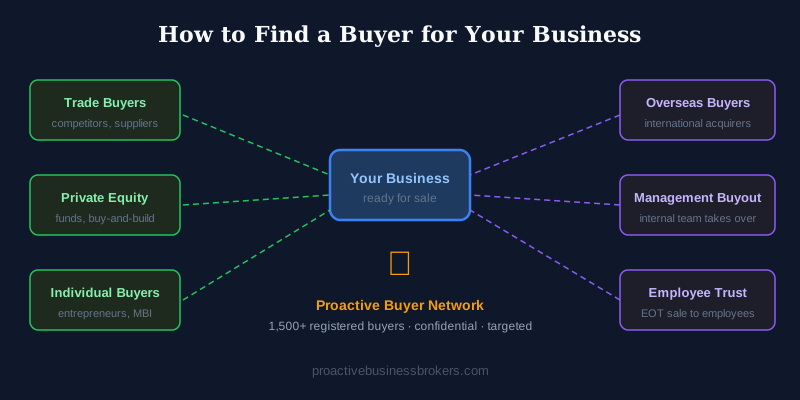
Key Takeaways: There are six main buyer types for UK business sales: trade buyers, private equity, individual buyers, overseas acquirers, management buyouts, and Employee Ownership Trusts. The right buyer for your business depends on its size, sector, and what you want from the sale. A proactive approach — using a registered buyer network and targeted outreach — consistently delivers better outcomes than passive listing alone.
Why finding the right buyer matters
The difference between finding the right buyer and accepting an offer from whoever responds to a listing is enormous — in both price and outcome. A motivated trade buyer who sees strategic value in your business will pay a premium. A private equity firm looking for a platform acquisition will approach the deal differently from an individual buyer wanting a lifestyle change. Understanding who buys businesses like yours, and how to reach them, is the foundation of a successful sale process.
Many business owners assume that putting a business on a listing site is sufficient. For some businesses it is — but for the majority, the best buyer won't be browsing Business For Sale at 10pm on a Tuesday. They'll be on a broker's registered buyer list, or identified through a targeted outreach campaign.
The six types of business buyers
Trade buyers are companies operating in the same sector or an adjacent one. They typically pay the highest premiums because they can capture synergies — your customer base complements theirs, your technology fills a gap in their product, or your team accelerates their geographic expansion. For businesses with strong recurring revenue and clear sector fit, trade buyers are often the most motivated and best-funded acquirers.
Private equity and growth capital: PE firms are institutional buyers who acquire businesses to grow them and exit within 3–7 years. They are particularly active in sectors with fragmented markets where a buy-and-build strategy makes sense. PE buyers are sophisticated, have significant capital, and move quickly once interested — but they expect strong management teams to remain in place and will want detailed financial information.
Individual buyers are entrepreneurs, ex-executives, or career changers looking to buy rather than start a business. They tend to focus on businesses with EBITDA of £100k–£1m, often looking for an owner-managed business they can run themselves. This pool is large and active — business transfer agents and listing sites reach these buyers effectively.
Overseas buyers are companies or investors based outside the UK who see the business as a route to market entry, access to UK-listed assets, or strategic geographic expansion. Some sectors attract strong overseas interest — technology, healthcare, education, and professional services in particular.
Management buyout (MBO) buyers are your existing management team. They know the business better than any external buyer, which removes information asymmetry and can accelerate the process. As outlined in our guide to MBOs, the main considerations are funding complexity and the inherent tension of negotiating with people you work with every day.
Employee Ownership Trusts represent a growing buyer pool — particularly for businesses where the owner values employee legacy and can structure a deferred consideration arrangement. As covered in our EOT guide, the CGT exemption for sellers is a significant incentive.
How do professional brokers find buyers?
A good broker brings significantly more to the buyer sourcing process than a listing. The core methods are:
Registered buyer database: Established brokers maintain databases of active, qualified buyers — individuals and companies who have registered their acquisition criteria, been through a financial pre-qualification process, and are actively looking to acquire. Matching your business against this database is often where the best-fit buyers emerge.
Targeted strategic outreach: For trade and PE deals in particular, the right buyer may not be on any database. A proactive broker will identify companies and funds that would logically value your business — through sector knowledge, company research, and professional networks — and approach them confidentially on your behalf.
Listing site presence: Business sale portals (Rightbiz, BusinessesForSale, Daltons) attract individual buyers and some smaller trade acquirers. For businesses targeting this segment, listing sites are a useful channel — but they should be one element of a multi-channel approach, not the whole strategy.
Professional networks: Accountants, solicitors, and corporate finance advisers frequently refer acquisition opportunities to broker contacts. A broker with strong professional network relationships can access off-market buyer opportunities through these referral channels.
Sector-specific channels: For some businesses, the right buyers are reached through trade associations, industry events, or sector publications. A broker with genuine sector knowledge can leverage these channels effectively.
What makes a buyer the "right" buyer?
The highest offer isn't always from the right buyer. A motivated buyer who can demonstrate funding, has genuine strategic rationale, and is prepared to move at pace is often more valuable than a higher headline offer from someone who is slow to perform or whose funding is uncertain.
Buyer qualification matters as much as buyer identification. A professional broker will assess financial capacity, genuine motivation, and commercial credibility before exposing sensitive business information — protecting your confidentiality and your time.
What can sellers do to maximise their chances of finding a buyer?
Beyond appointing a good broker, there are practical things sellers can do to increase buyer interest and transaction certainty.
Prepare properly before going to market. Buyers are more interested in well-prepared opportunities. Clean accounts, clear financial performance, documented systems, and reduced owner dependency all make your business more attractive and reduce the risk of deals falling apart in due diligence.
Know your buyer type. Understanding which buyer category your business is best suited to allows you to focus your energy in the right place. A £10m turnover business with a unique technology proposition needs a very different approach to a £500k-turnover owner-managed service business.
Allow realistic timescales. Trying to force a sale in 90 days almost always produces a worse outcome than a properly managed 9–12 month process. Giving your broker time to find the right buyer — rather than the first willing one — consistently delivers better outcomes.
Maintain confidentiality. Leaks to competitors, suppliers, or staff create serious problems. Work with your broker to manage confidentiality rigorously, using NDAs and controlled information release throughout the process.
Frequently asked questions
How long does it take to find a buyer for a business?
In a well-managed process, serious buyer interest typically emerges within 2–4 months of going to market. The time from first approach to Heads of Terms is typically 3–6 months, with legal completion a further 2–4 months beyond that. Businesses that are well prepared and priced at a realistic market value tend to attract buyers faster.
Can I find a buyer for my business without a broker?
Some business owners do complete sales without a broker — typically where they already have a known buyer in mind, such as a management team or a known trade competitor. For most sellers, however, the incremental value delivered by a good broker — better buyer identification, stronger negotiation, process management, and confidentiality protection — far exceeds the fee cost.
Should I approach competitors about buying my business?
Directly approaching competitors carries significant risks — they may use the conversation to gain competitive intelligence rather than genuinely acquire. If competitors are on your target buyer list, the approach is better made confidentially through a broker who can gauge interest without revealing the seller's identity or willingness to sell.
What information do buyers want to see?
Buyers will typically want to see 3 years of management accounts, details of key customer contracts and concentration, information on staff and management structure, details of any IP or key assets, and a clear picture of owner involvement. This information is shared in a controlled way — typically under NDA and in stages as buyers progress through the process.
Useful next steps
Ready to go further? These free tools and guides are a good place to start.
Thinking about what’s next for your business?
Book a confidential, no-obligation discovery call and let’s talk through your options.