Insights
Selling a Business Advice: The 7 Things Your Broker Should Do for You
Not all business brokers are equal. This guide sets out the seven things a good broker should do — and what to look for when choosing who to represent you in the sale of your business.
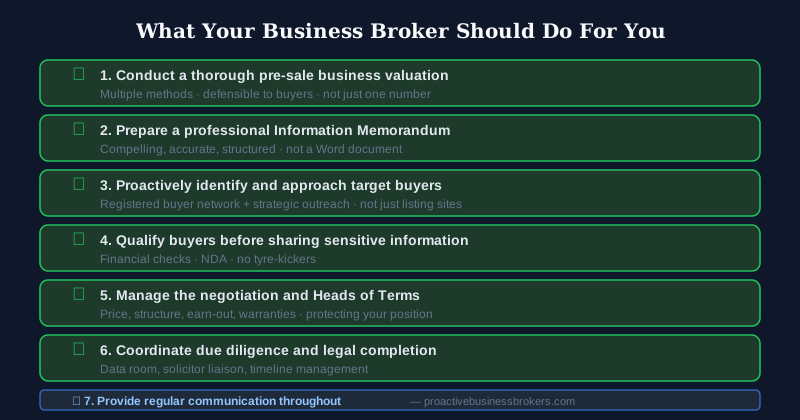
Key Takeaways: Appointing the right broker is one of the most important decisions you'll make in selling your business. A good broker does far more than list your business online — they value it properly, prepare professional materials, source the right buyers, manage the negotiation, and get you to completion. Here are the seven things you should expect, and demand, from yours.
Why broker quality matters more than you think
The difference in outcome between an average broker and a good one is not marginal. It shows up in the sale price achieved, the number of qualified buyers in the process, the deal structure negotiated, and whether the transaction completes at all. Studies consistently show that professionally brokered business sales achieve higher multiples and higher completion rates than unrepresented or poorly-represented sales.
Yet the market for business brokers is opaque. Fees and credentials vary widely. Some operate nationally with deep sector knowledge; others are generalists who list businesses online and wait for enquiries. Understanding what good looks like — and asking the right questions before appointing — will serve you well.
1. Conduct a thorough pre-sale business valuation
The starting point for any sale process is understanding what your business is worth — and why. A proper valuation uses multiple methods: earnings multiples (EBITDA), revenue multiples, asset values, and comparable transaction data. It identifies the specific value drivers that make your business attractive to buyers, and the factors that might suppress the valuation that you can address before going to market.
A valuation that is simply a headline multiple applied to last year's EBITDA is not a valuation — it's a rough guide. A good broker will give you a defensible, evidence-based view of market value and explain what a motivated buyer in your sector is currently paying. This matters not just for setting an asking price, but for giving you realistic expectations from the outset.
2. Prepare a professional Information Memorandum
The Information Memorandum (IM) is the principal document presented to potential buyers. It needs to tell a compelling, accurate, and well-structured story about your business — covering financial performance, the management team, customers and contracts, the market opportunity, and the investment case.
A well-crafted IM significantly increases buyer engagement and reduces the number of unnecessary questions in the early stages of a process. A poorly prepared one — a Word document with inconsistent formatting and vague financial summaries — signals to experienced buyers that the process is not being run professionally. First impressions matter.
3. Proactively identify and approach target buyers
Passive listing is not a buyer identification strategy. For most businesses, the best buyer is not browsing a listing site — they're on a broker's registered buyer database, or identifiable through sector knowledge and company research.
Your broker should be able to explain their buyer sourcing approach: who is on their database, how they qualify registered buyers, and what targeted outreach they will conduct beyond the database. For trade and institutional buyers in particular, proactive outreach — approaching identified acquirers on a confidential, no-name basis — is often what creates the competitive dynamic that drives price.
4. Qualify buyers rigorously before sharing sensitive information
Not everyone who expresses interest in your business is a serious buyer. Time-wasters, information gatherers, and competitors conducting intelligence exercises are a real hazard. A broker who shares your financial information with anyone who asks is exposing you to risk.
Buyer qualification should include: a signed NDA, evidence of financial capacity, a credible explanation of strategic rationale, and a professional conversation that tests genuine interest. Only buyers who pass these checks should receive the Information Memorandum. Only buyers who demonstrate serious intent should progress to detailed financial information.
5. Manage the negotiation and Heads of Terms
Negotiating the sale of your business is not like negotiating a property purchase. The variables are complex — headline price, deal structure (whether that's shares or assets), consideration timing (upfront vs. deferred), earn-out arrangements, working capital adjustments, warranties and indemnities, and the seller's post-completion obligations.
A good broker manages this process actively. They present your business as a competitive opportunity, create tension between multiple interested parties where possible, and help you navigate the structure of a deal to maximise what you actually receive — not just the headline figure. Heads of Terms, agreed before legal contracts are drafted, should capture all of these elements clearly.
6. Coordinate due diligence and legal completion
Due diligence is where many deals slow down or fall apart. Buyers and their advisers will scrutinise financial records, legal contracts, customer relationships, operational systems, and anything else material to the business. A well-prepared data room and responsive management of information requests keeps the process moving and maintains buyer confidence.
Your broker should also act as a conduit between your solicitor and the buyer's solicitor — not substituting for legal advice, but keeping the commercial momentum going and preventing deals from getting bogged down in legal process.
7. Provide regular, proactive communication throughout
Selling a business is a stressful process. It typically takes 9–18 months from engagement to completion. Throughout that period, you need a broker who keeps you informed — about buyer feedback, market conditions, process status, and what's coming next — rather than one who goes quiet and resurfaces only when there's news.
Ask any broker you're considering how often they provide updates, what their communication process looks like during due diligence, and how they handle situations where a deal slows down or a buyer withdraws. The answers will tell you a lot about how they will represent you.
Questions to ask before appointing a broker
Beyond the seven responsibilities above, here are the questions worth asking any broker before you appoint them:
How many businesses do you have on your books currently, and how many sold in the last 12 months? What is your average time to completion? What does your buyer database look like — how many registered buyers, and how are they qualified? What is your fee structure, and when do you charge? Do you work exclusively, or do you co-broker? Can you provide references from recent sellers in my sector?
The answers will give you a clear sense of whether the broker has the capacity, track record, and professional approach to represent your interests effectively.
Frequently asked questions
How much do business brokers charge in the UK?
Fee structures vary considerably. Most UK business brokers charge a success fee — typically between 3% and 8% of the sale price — payable on completion. Some also charge an upfront engagement fee or a retainer to cover preparation work. For smaller businesses, minimum success fees typically apply. Always clarify the full fee structure before signing an engagement letter.
Should I use more than one broker to sell my business?
Multiple agency arrangements are possible but generally not recommended. They can dilute the effort any single broker puts in, create confidentiality risks if the same buyer receives approaches from multiple sources, and complicate the negotiation and completion process. A well-chosen sole agency arrangement with a good broker tends to deliver better outcomes.
How do I know if a broker is good?
Ask for evidence: completed transactions in the last 12 months, references from recent sellers, sector experience, and a clear articulation of their buyer sourcing approach. Professional memberships (TISA, NACFB, or similar) provide some assurance of professional standards. Trust your instincts — a broker who is evasive about their track record or who oversells the value they can achieve is worth approaching with caution.
What is an exclusive listing agreement?
An exclusive listing agreement gives one broker the sole right to represent your business for sale for a defined period — typically 6–12 months. In exchange for exclusivity, you should receive the broker's full commitment: active buyer sourcing, professional documentation, and dedicated process management. Read the agreement carefully before signing, and ensure the exclusivity period and notice terms are reasonable.
Useful next steps
Ready to go further? These free tools and guides are a good place to start.
Thinking about what’s next for your business?
Book a confidential, no-obligation discovery call and let’s talk through your options.