Insights
What is a Management Buyout (MBO)? A Plain-English Guide for UK Business Owners
A management buyout (MBO) lets your existing management team buy the business from you. Here's how they work, when they make sense, and what sellers need to consider.
Key Takeaways: An MBO (management buyout) is when your existing management team purchases the business from you. MBOs are typically funded through a combination of private equity, bank debt, and management's own investment. They offer a smoother transition than a third-party sale but may deliver a lower headline price. Most UK MBOs complete within 6–12 months once a deal structure is agreed.
What is a management buyout?
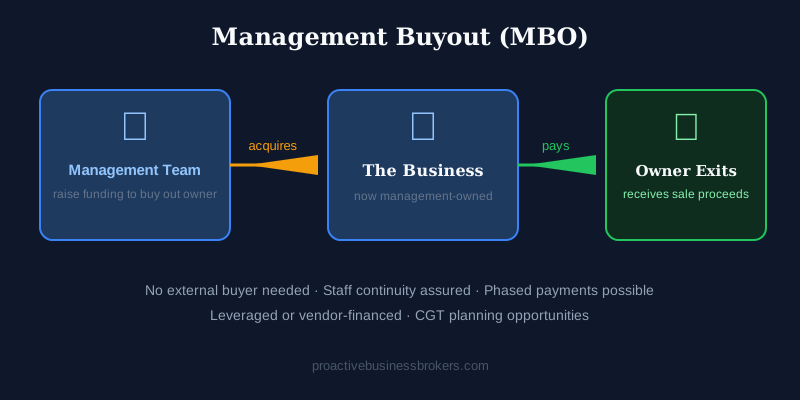
A management buyout (MBO) is a transaction in which the existing senior management team of a business purchases it from the current owner — whether that's a founder, a larger corporate parent, or an institutional shareholder.
MBOs are a well-established exit route in the UK. They work particularly well where the management team has strong operational knowledge, where continuity matters to customers or staff, and where the owner wants to exit without a lengthy marketing process to unknown third parties.
The fundamental appeal for sellers is straightforward: you're handing the business to people who already understand it and are invested in making it succeed. For the management team, it's the opportunity to become owners — with all the upside that brings.
How is an MBO typically funded?
This is the question most sellers ask first — and rightly so, because management teams rarely have the personal capital to fund a full acquisition. MBOs are almost always structured as a combination of funding sources:
Private equity or growth capital: An institutional investor takes a minority or majority stake, providing the bulk of the funding. The investor typically expects a return over 3–5 years and will want an exit strategy of their own.
Bank debt: Senior debt from a bank or specialist lender is secured against the business's assets and cash flows. The business effectively takes on debt that is repaid from future trading profits.
Management's own investment: The management team invests personally — often a meaningful amount relative to their own wealth — to demonstrate commitment and align incentives with investors.
Vendor loan notes: In some cases, the seller agrees to defer a portion of the purchase price as a structured loan note, repaid over several years from the business's profits. This bridges any gap between what the buyer can fund and what the seller wants.
The relative proportions depend on the deal size, the business's financial profile, and the appetite of lenders and investors at the time.
What are the advantages of an MBO for the seller?
Continuity and confidentiality: The business doesn't go to market. There's no information memorandum sent to competitors, no beauty parade of unknown buyers, and no disruption to staff during a lengthy process.
Speed: Once both sides are aligned, MBOs can move faster than a full sale process. The management team already knows the business — there's no due diligence learning curve.
Soft factors: Many owners care about legacy — what happens to their people, their culture, their customers. An MBO often provides stronger continuity assurances than a trade sale.
Flexibility on structure: Sellers are often willing to be creative on deal structures in MBOs — deferred consideration, vendor loans, earnouts — in a way they might not be with a third-party buyer they've never met.
What are the disadvantages for sellers?
The main trade-off is price. A management team, however capable, is unlikely to pay the same premium that a motivated trade buyer with genuine synergies might offer. Strategic acquirers can often justify paying more because the combined entity is worth more than the sum of its parts.
There's also an inherent tension in the negotiation: the same people you rely on to run the business day-to-day are now sitting on the other side of the table. That dynamic requires careful management and clear professional advice on both sides.
Finally, there is funding risk. If the management team cannot secure sufficient investment or bank debt, the deal may not complete — and you've spent months on a process that goes nowhere.
When does an MBO make sense?
An MBO is worth exploring when the management team has expressed genuine interest in ownership, when the business has strong recurring cash flows that can service acquisition debt, when continuity is a priority for the owner, and when a full market process would be disruptive or the pool of strategic acquirers is limited.
Businesses with EBITDA of £500k upwards tend to be better placed for MBOs, since the deal needs to be large enough to attract institutional funding. Below that level, the funding structure becomes harder to piece together.
How does the MBO process typically work?
The process usually begins with a conversation — the management team approaches the owner, or the owner floats the idea. Once both sides are aligned in principle, each appoints their own advisers. The management team engages a corporate finance house to find equity backing and arrange debt. The seller instructs a solicitor and, ideally, a business broker or M&A adviser to represent their interests.
Heads of Terms are negotiated covering price, structure, and key conditions. Due diligence follows — usually faster than in a third-party sale because the buyers already know the business. Legal completion typically takes 2–4 months from Heads of Terms.
MBO vs trade sale: which is right for you?
The right answer depends on your priorities. If maximising sale price is paramount and you have strategic buyers who would pay a premium, a full market process is likely to deliver a better outcome. If continuity, speed, and confidentiality matter more — and if your management team is strong enough to run the business independently — an MBO deserves serious consideration.
Many owners run a parallel process: test the market to establish value, while simultaneously exploring the MBO option. This gives you leverage in both negotiations and ensures you're not leaving money on the table.
What tax treatment applies to MBO proceeds?
Proceeds from an MBO are treated the same as proceeds from any other business sale for UK tax purposes. Business Asset Disposal Relief (BADR) — formerly Entrepreneurs' Relief — may apply, reducing Capital Gains Tax to 14% (rising to 18% from April 2026) on the first £1 million of qualifying gains, subject to eligibility conditions around ownership period and trading activity. Proper structuring and advice from a tax specialist is essential before agreeing any deal.
Frequently asked questions
Can a small business be bought out by its management team?
Yes, though smaller businesses (below £500k EBITDA) can be harder to fund through traditional private equity and bank debt structures. Owner-financed MBOs — where the seller accepts deferred payments — are more common at the smaller end of the market.
How long does an MBO take to complete?
From first discussion to completion, most MBOs take 6–12 months. The funding raise for the management team is often the longest element. Once funding is in place and Heads of Terms are signed, legal completion typically follows within 2–4 months.
Do I need a broker for an MBO?
Yes. Even though you know and trust your management team, you need independent representation. A broker or M&A adviser will help you assess whether the offer is fair, negotiate the structure, and protect your interests throughout — especially where the management team has institutional backing with experienced advisers of their own.
What happens to staff in an MBO?
TUPE (Transfer of Undertakings Protection of Employment) regulations apply to MBOs in the same way as other business transfers, protecting employees' existing terms and conditions. In practice, MBOs tend to result in less disruption to staff than trade sales because the management team and culture remain in place.
Useful next steps
Ready to go further? These free tools and guides are a good place to start.
Thinking about what’s next for your business?
Book a confidential, no-obligation discovery call and let’s talk through your options.